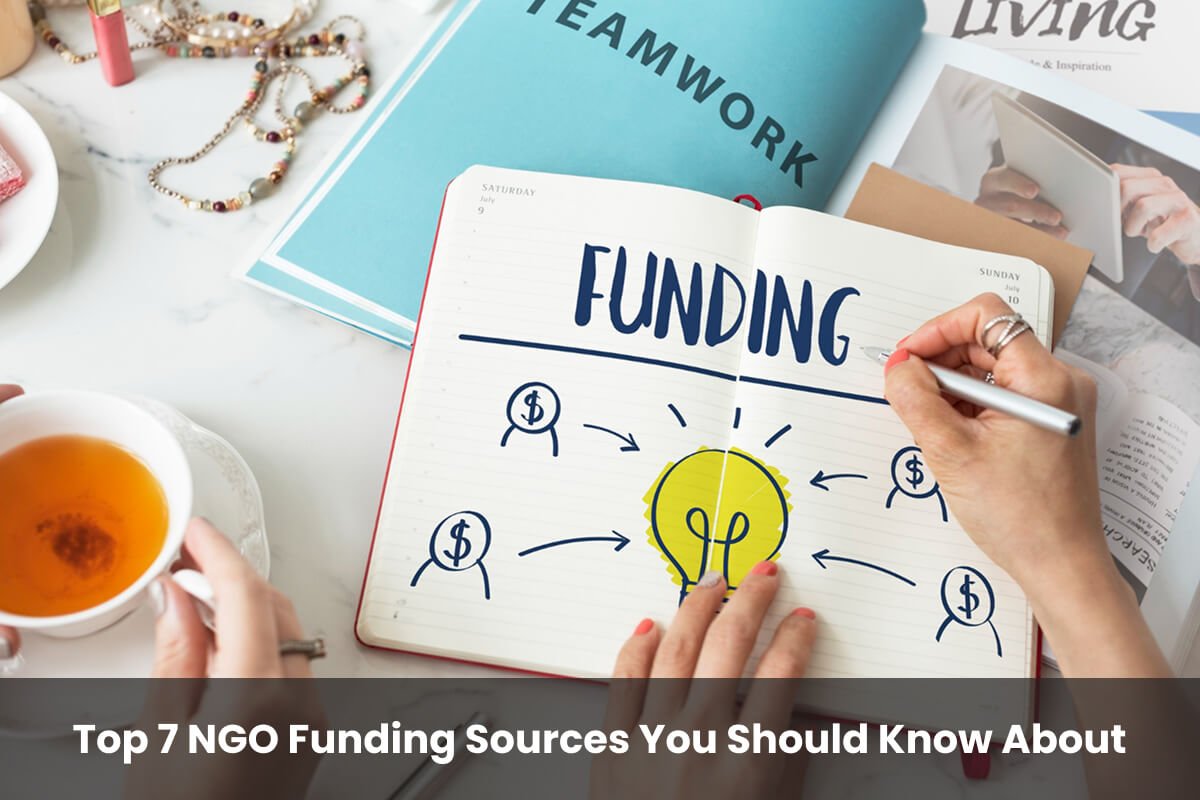
Initially, an NGO is nothing but a dream – a dream to turn the world around. The dream of feeding children, of empowering women, saving the planet or taking education to remote areas; every initiative is born out of a dream. But even the brightest of dreams cannot light the world alone. To convert the idea into action, the money has to be the backbone of the NGO movement that not only keeps it alive but also makes it grow.
Without financial support, no NGO, even the most passionate one, could function – this is the reality. Payment of staff, fieldwork, awareness campaigns, and the general running of the organization all require money. It is for this reason that locating the right sources of funding and figuring out how to approach them is indispensable to the stability of an NGO.
So far as you are concerned, if you have ever been curious about the sources of money for NGOs or the methods of finding funding partners, this manual will show you the seven major funding sources for NGOs and the best ways of utilizing them.
Why Knowing Funding Sources Matters?
Most of the time non-governmental organizations (NGOs) talk about their big ideas with a lot of energy and ambition, but quite a few of them are not able to keep their programs going due to poorly funded projects. The problem is not that there are no good works, but that there is a lack of knowledge concerning the sources of funds and the ways of getting access to them.
Understanding your funding options has the following advantages:
- First, you will be able to diversify your sources of income thus reducing the risk of being dependent on one single donor.
- Secondly, you will be able to plan your projects in a more effective way by adjusting your activities to the type of funding that is at your disposal.
- Moreover, you have the possibility to nurture long-lasting relationships with funders who are really interested in your mission.
- On top of that, you will be able to reach a larger number of communities with your influence if you have regular financial support.
It is similar to learning how to use a map when figuring out how to access different funding sources – once you know where to look, you can easily plan a sustainable path for your NGO going forward.
Top 7 NGO Funding Sources
Today, seven most reliable and efficient ways can be found for NGOs to raise funds – each way having its own set of advantages and possibilities.
1. Individual Donations
This is the major and most common source of NGO financing. Besides, emotionally, it is the most rewarding one. In particular, individual donors do this because they firmly trust the cause that you are supporting. Such donations can be done through your NGO’s website, social media, or by the means of offline campaigns.
Freedom is still the most important advantage of money from individuals – it is usually less restricted. In addition, with good storytelling and frequent communication, you have a great potential to turn one-time donors into indefinite supporters.
Pro tip: Use your own stories and real-life examples of what your work has achieved. People will give money when they can see the result of their investment.
2. Corporate Social Responsibility (CSR) Funding
With the CSR law implementation in India, companies are required to set aside a part of their profits for social and environmental projects. This has created a huge gate for the non-governmental sector to work with corporations.
With the support of CSR, NGOs may extensively influence the following issues: quality education, healthcare, women’s empowerment, and environment-friendly projects. To win CSR partners, NGOs need to be operationally transparent, have measurable results, and most importantly, be in harmony with the company’s focus areas.
Pro tip: Be familiar with the corporate CSR policies before a pitch. Make your pitch reflect their goals — it demonstrates your professionalism and hence, your chances of getting approved are higher.
3. Government Grants and Schemes
Both the central and state governments of India provide various grants, subsidies, and welfare programs for non-governmental organizations (NGOs) involved in rural development, child welfare, sanitation, and skill training sectors.
Such grants usually come along with projects and require NGOs to fulfill certain eligibility criteria. The government funding can be a source of stability and long-term support, albeit the application process is formal and time-consuming.
Pro tip: Always be ready for the latest resources and schemes by keeping up to date with government portals like NGO Darpan and MyGov.
4. International Funding Agencies
There are several international agencies and foundations, e.g., UNDP, UNICEF, Bill & Melinda Gates Foundation, and USAID that offer grants, assistance, or joint ventures to Indian NGOs.
At the same time, Indian NGOs that want to receive foreign funding should have FCRA (Foreign Contribution Regulation Act) registration. The majority of international grants are quite liberal and frequently allocate money to areas such as poverty alleviation, health, education, and human rights.
Pro tip: Focus your efforts on reporting and being accountable — this is where international donors put their money.
5. Crowdfunding Platforms
Crowdfunding is a method through which NGOs can obtain funding by means of small donations from a large number of people over the internet. It is a perfect solution for start-ups or small organizations which have not yet secured the support of big corporations or the government.
Anyone can very quickly initiate a campaign, tell their story, and connect with thousands of potential donors by using crowdfunding platforms such as Ketto, Milaap, ImpactGuru, and Donatekart. The more your story is relatable and touches the emotions of people, the more likely it is that people will give you money.
Pro tip: To engage your donors, provide them with access to videos, real pictures, and sincere updates on your cause.
6. Foundations and Philanthropic Trusts
There are numerous charity foundations and trusts both within India and overseas that offer assistance to NGOs working in various sectors. Among them, these may be Tata Trusts, Azim Premji Foundation, and Ford Foundation.
In most cases, these funders come with support for long-term projects and lean towards choosing those NGOs which have a detailed strategy, a team of competent and experienced members, and have already made some achievements. Receiving a grant is like scaling a steep mountain, but once you do it, you will find the door to lucrative grants wide open.
Pro tip: Enhance your grant application with precise data, success stories, and a well-structured sustainability plan.
7. Membership and Subscription Programs
Some NGOs operate donation models through membership that allows individuals to make small donations monthly or yearly. In return, they get updated information, event invitations, and maybe volunteer offers.
By implementing this method, NGOs prove that they are able to create a sustainable and predictable source of income as well as a community of supporters, who are the core, and who feel personally connected to the mission and its success.
Pro tip: Offer your members engaging content — newsletters, behind-the-scenes updates, or thank-you notes. People like to be involved.
Tips to Maximize Your Funding Opportunities
The next step after understanding where your funds are coming from is to spend them in such a way that will generate the highest return. Would you like to implement these proposals?
- Donors Diversification: Do not rely on only one source of funds. You are required to maintain a proper balance of donors such as individuals, corporations, and grants.
- Start communication: Delivering yearly reports and giving the donors information concerning the use of their money are communication means.
- Make use of stories: Explain the influence of your work on people through stories, photos, and a video statement.
- Regular networking: CSR events, NGO fairs, and webinars are some of the places where you can meet potential funders.
- Proposal Refinement: Make sure that each grant proposal you send is aligned with the donor’s ethics, language, and objectives.
With fundraising, not only does it become achievable — but it becomes influential as well, if you use the brain of a plan and the spirit of a dream.
Online Fundraising Platforms for NGOs
What if you move to the online platform of your NGO’s fundraising efforts? If the answer is yes, then the way to go would be to liquidate your efforts by launching through some reliable platforms.
- Ketto: It is one of the leading Indian platforms for raising funds in the medical, educational, and social sectors through the collective efforts of the crowd.
- Milaap: This platform opens up fundraising avenues for individuals and NGOs through various payment methods. Besides, it allows for easy campaign tracking.
- ImpactGuru: The brand places the major emphasis on the projects that are related to the health and general wellness of the community. Both local and foreign donors can contribute their share.
- GiveIndia: The platform is the provider of listings of the verified NGOs and is completely transparent in the allocation of funds.
- Donatekart: Here, for instance, a donor if he wants to, can contribute to the buying of necessary items rather than giving money straightly.
- GlobalGiving: It is committed to providing support and assistance to Indian NGOs for relationship-building with foreign partners and donors.
Besides being a great tool for facile fundraising, these platforms also bestow NGOs with prestige and open them up to the whole world audience.
Related Blog: How to Raise Funds for an NGO: A Step-by-Step Guide
FAQs About NGO Funding Sources
Q1. How do I apply for corporate CSR funding?
The initial point is to find out the companies which have a CSR focus that matches the mission of your NGO. After that, you ought to draft a comprehensive proposal emphasizing the objectives, expected results and the way the impact will be measured for the next step. Establish contact with the CSR department and continue with your follow-up communication. Whatever you do, always be transparent and professional which are the two most important things and they should be your attitude all the time.
Q2. Which crowdfunding platform is best for NGOs?
In India, platforms like Ketto, Milaap, ImpactGuru, and Donatekart are pretty popular among users. The best one depends on your project type — eg. healthcare projects can get more support on the platform like ImpactGuru whereas if you are looking for material donations then Donatekart would be more appropriate.
Q3. Can NGOs get international funding?
Certainly, NGOs can obtain international funding provided that they are registered under India’s Foreign Contribution (Regulation) Act (FCRA). This is done to maintain law-abiding and transparent foreign contributions. In this respect, agencies like UNICEF, UNDP, and Oxfam that operate internationally regularly fund NGOs that are registered in India.
Q4. How can small NGOs get funds easily?
You may consider a small NGO as a startup business, in a local area, build a strong network, try crowdfunding and approach individual donors. Collaborating with larger NGOs to run joint projects, applying for micro-grants or CSR programs for small community initiatives are a few more ideas for small NGOs.
Q5. What is the role of government grants in NGO funding?
Government grants invest in NGOs to carry out extensive projects that contribute to national goals – for instance, education, rural development, or environmental protection. Though these funds usually come with particular stipulations, they provide long-term assistance to impactful initiatives.
Conclusion
If we were to put it simply, Funding is the base that transforms great ideas into real change. For NGOs, it is vital to comprehend different sources of funding not only from a financial perspective, but also as a necessity for their continuation.
Where to get funds from – i.e., individual donors, CSR partners, crowdfunding platforms, government schemes – each source is a door leading to the opportunities of expansion, innovation, and impact creation. With qualities like transparency, accountability, and good narrative, NGOs can get hold of the type of partners that will help them live their mission not only for the foreseeable future but also beyond it.
Note that people do not provide funding for projects, instead, they fund the underlying purpose that those projects serve.
Simplify NGO Fundraising — Partner with Social For Action
It’s our belief at Social For Action (SFA) that no less than every good cause should get the best kind of support. Our platform offers a solution to NGOs to link up with authentic donors, CSR partners, and use the fundraising instruments which bring about the ease, speed, and transparency of raising funds.
It does not matter if you are a tiny NGO that is barely taking the first steps or a big-brand organization that is seeking to grow. SFA is there to assist you in discovering the good fit for your opportunities and running the campaigns smoothly.
We simplify fundraising by working together. So, you are free to concentrate on the things that really matter: making a difference that lasts.





Post a Comment