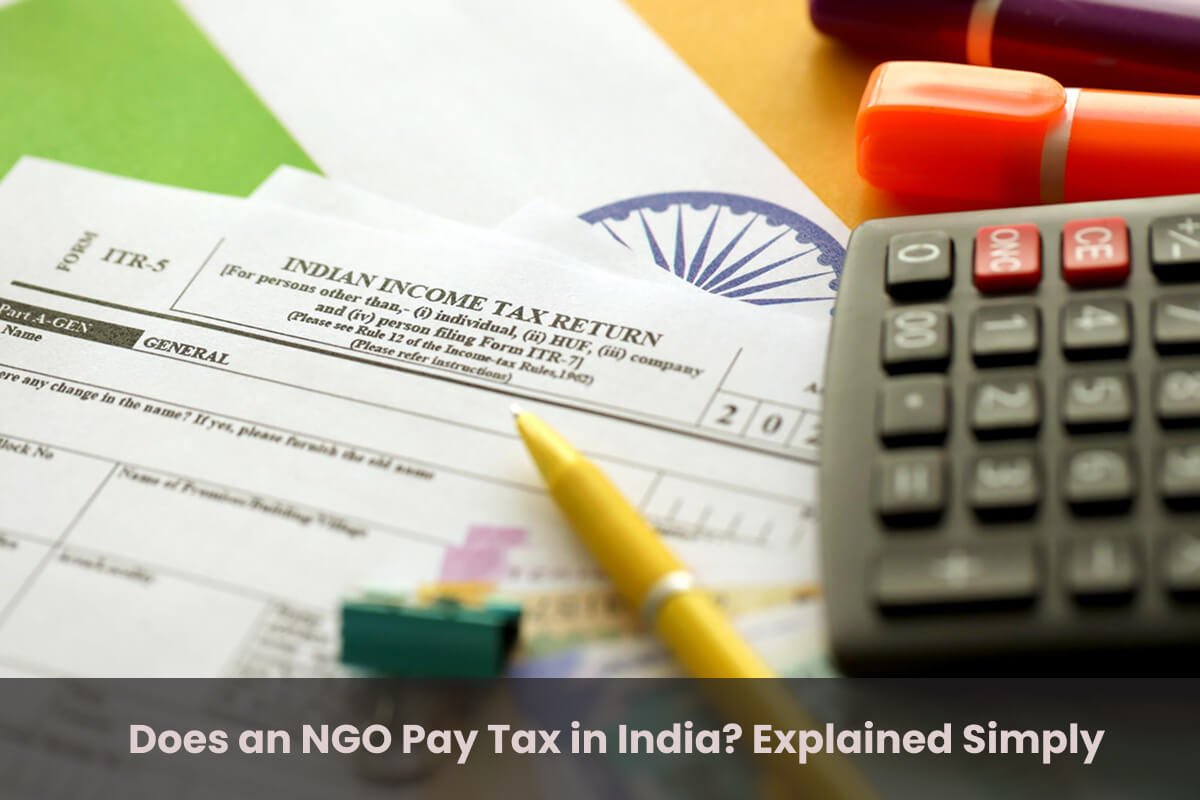
Non-Governmental Organizations (NGOs) are the social change agents that make up the backbone of India. These are the entities, which without any kind of break, strive towards educating children, empowering women, protecting the environment, and uplifting the underprivileged sections of the society. However, apart from their humanitarian mission, NGOs are in need of funds to continue with their operations – which, as a result, naturally brings up a question: Are NGOs in India obligated to pay tax?
The answer to this is not very straightforward. It takes into consideration the registration of the NGO, the type of income the entity has, and the fact if it is obeying the rules for tax exemption. The government of India offers special assistance to the real NGOs so that they can use their resources more efficiently for the benefit of society instead of paying taxes.
The article simplifies a complex topic into understandable chunks — taxation of NGOs, which exceptions are there, and if at times, an NGO needing to pay tax.
What Is an NGO and How It Operates?
NGO (Non-Governmental Organization) is a non-profit organization that does not work for profit but for the welfare of society. It may be a trust, a society, or a section 8 company under Indian law.
Although private companies are mainly involved in creating wealth, NGOs are concerned with the social good of the society — yet they cannot do without money to finance their operations, pay their employees, and provide programs. Such money is mostly from donations, government grants, or CSR partnerships.
Being that NGOs utilize their funds for the benefit of the public, the government gives them exemptions on taxes so as to encourage them to do more social work and lessen their financial burden. However, to avail such benefits, NGOs should be registered under certain sections of the Income Tax Act.
Related Blog: What is NGO and Its Functions: A Comprehensive Guide
Are NGOs Taxed in India?
Generally, any income earned in India is liable to tax according to the Income Tax Act — however, NGOs get some privileges. An NGO registered under Section 12A of the Income Tax Act will have its income fully exempted from tax, provided the income is derived from charitable or religious activities only.
This implies that an NGO is not liable to pay income tax on donations or grants if it utilizes such donations or grants for the original purpose of the NGO.
On the other hand, NGOs should maintain proper books of accounts, file annual returns, and adhere to compliance regulations. Failure to do so may result in the revocation of the tax exemption.
Understanding 12A and 80G Registrations
Every NGO should be aware of Section 12A and Section 80G – these are the two most important registrations. Both of them have a lot of tax benefits – one is for the NGO and the other is for the donors.
Section 12A — Income Tax Exemption for NGOs
What it is:
Section 12A is the one that permits NGOs to get income tax exemption on their net income. If the NGO is not registered under 12A, then the whole income of the NGO will be taxed like that of any other business.
Eligibility:
Any NGO that is carrying out one or more of the activities of the charitable, educational, social, or religious nature, may apply for this exemption. An application with necessary documents like registration certificates of the NGO, PAN card and activity reports should be sent by the organization to the Income Tax Department through Form 10A.
Benefits:
- Exemption from paying income tax on donations and grants.
- An opportunity to obtain funding from CSR and the government.
- The recognition as a charitable institution.
- Facilitated access to foreign contributions (with FCRA registration).
Section 80G — Donor Tax Benefits
What it is:
By giving tax concessions to donors who donate to registered NGOs, Section 80G is the way to go. Hence individuals or companies would be allowed to deduct a certain portion of their donation from their taxable income.
Eligibility:
NGOs with 12A registration are eligible to file for 80G permission. The organization should keep proper account records and must use the received donations only for the approved activities of the charity.
Benefits:
- The donor is entitled to a tax deduction which can be either 50% or 100% of the amount of the donation made.
- Enables charities to attract more donors – individuals and corporations.
- The charity builds more credibility and thus becomes more trusted.
Simply put: 12A is for the NGO, and 80G is for the donor — both are necessary for the NGO to be sustainable long-term.
When Does an NGO Have to Pay Tax?
There are always possibilities of certain situations which would require NGOs to be taxed even though they usually are exempted from taxation. Such cases include the following:
- If it doesn’t have registration 12A or 80G.
- If funds are being used for non-charitable purposes (personal benefit or business unrelated to the cause).
- If over 15% of total income is accumulated without the approval of the Income Tax Department.
- If donations come from anonymous or undisclosed sources.
- If the NGO has a profit-making business that is not related to the mission.
Basically, if an NGO moves away from its original charitable goals or fails to meet the compliance requirements, it can have its tax exemption taken away.
Important Tax Compliance Rules for NGOs
Non-governmental organizations need to abide by certain regulations if they desire to keep their park-exempt status:
- They should initially register under sections 12A and 80G to be entitled to exemptions.
- Income Tax returns should be filed annually (Form 10B/10BB).
- The NGOs must keep proper books of accounts and receipts.
- Granting of funds should be strictly in line with the charitable objectives specified.
- Profits or dividends should not be handed over to trustees or members.
- They should renew their registration from time to time as per the requirements of the new tax regulations.
Observance of the rules will enable an NGO to win the confidence of others and thus be able to operate smoothly both from a legal and financial point of view.
Common Mistakes NGOs Should Avoid
It is possible for even well-intentioned NGOs to see the loss of their tax benefits if they fail to take into consideration the compliance requirements. Here are the most common mistakes that you can identify:
- Running a business without 12A or 80G registration.
- The use of money for self or other purposes that are not related to the organization.
- Insufficient or incomplete record keeping.
- Not filing tax returns on time.
- Allowing foreign donations without obtaining FCRA permission.
- Not sharing financial transparency with donors.
If NGOs refrain from making such errors, they will be able to keep their credibility and have access to various sources of financing.
Benefits of Tax-Exempt Status
The possession of tax-exempt status is not only beneficial from the financial point of view. It also extends the NGO’s reputation and potential to grow.
The main advantages are:
- Exemption from the payment of income tax on eligible income.
- Easy access to funds from CSR, government, and international sources.
- Donors’ trust increases, and they become more engaged.
- The NGO becomes more sustainable in the long run.
- Legal recognition as a non-profit organization.
Once NGOs abide by the compliance regulations, tax exemption turns into a token of their honesty and professionalism.
FAQs About NGOs and Tax
Q1. Are donations to NGOs taxable?
Donors who make contributions to an NGO registered under 80G are not required to pay tax on such donations. In addition, donors are allowed to claim the donation made as a deduction in their tax returns.
Q2. Can a newly formed NGO apply for tax exemption?
Yes, a newly set up NGO may apply for the 12A and 80G registrations immediately after their establishment. It means enjoying the benefits of the tax system from the very beginning if one has the registration in the early stage.
Q3. What happens if an NGO doesn’t register under 12A?
In the absence of 12A certification, the income earned will be regarded as taxable. The charitable institution will not be entitled to any exemption even if it performs activities of a charitable nature.
Q4. What documents are needed for 12A registration?
These are the documents that you should submit: the certificate of the NGO’s registration, PAN, the founding documents (trust deed or memorandum), the list of trustees, activity reports, and bank account details.
Q5. Are CSR funds taxable for NGOs?
Funds for Corporate Social Responsibility (CSR) will not be taxed if the NGO has 12A registration and the funds are used for the approved charitable purpose. Meanwhile, if the funds are diverted or there is a false reporting, the organization will be responsible for taxes.
Conclusion
Without empathy, a Non-Governmental Organization (NGO) in India cannot run well — but still, it has to be compliant. Tax exemption is not automatically given; rather, it is achieved through registration, transparency, and proper utilization of resources.
By adhering to the law under 12A and 80G, NGOs may shift their focus from tax issues to the accomplishment of their mission. The arrangement works well for the organization and the donors — more funds become available for the purpose while less are lost to taxation.
Make a Difference — Partner with Social For Action to Create Real Impact
Social For Action (SFA) is not only about helping NGOs in fundraising but also about making them understand and manage compliance in an efficient way. By facilitating the process, which is less complicated and more transparent, SFA supports NGOs during their tax registration and brings them in contact with authentic donors.
Collaborating with us, you can use your time and resources on the things that really matter — creating a positive impact, empowering people, and building a better future for everyone.






Post a Comment