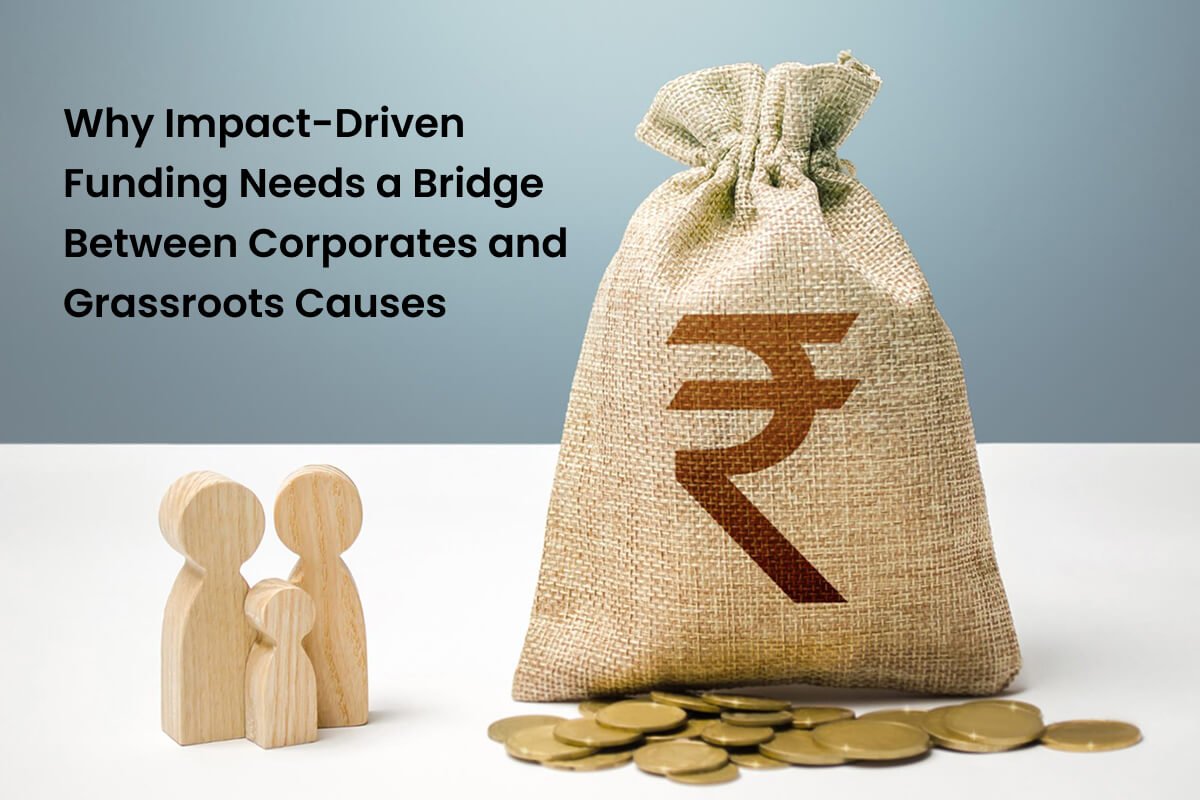
What Is Impact-Driven Funding?
Impact-driven funding shifts the focus from how much money is spent to what measurable difference that funding creates. Today, guests increasingly view friendly loan through the glass of Corporate Social Responsibility (CSR) and Environmental, Social, and Governance (ESG) obligations, seeking determinable impact and adjustment accompanying more extensive crucial goals.
This shift stresses consequence-met capital, where offerings are firm to particular public or tangible results rather than merely providing source of subsistence. Corporates immediately plan out projects that deliver transparence, scalability, and concrete benefits for societies, while still reflecting the company’s principles and unending assurance
The Gap Between Corporates and Grassroots Organizations
In the current CSR and ESG environment, not all initiative qualifies for allied support. Fundability is not any more almost bearing a good cause—it is about demonstrating skill and dependability.
A project is thought-out fundable when it balances various key factors: clear impact that addresses original needs, honesty through transparence and responsibility, adjustment with the company’s CSR aims or ESG foundation, and killing skill, meaning the action can transfer results capably and efficiently. Projects that meet these criteria are well-located to entice maintained allied loan.
Why Corporate Funding Often Misses Local Impact
Corporates are more likely to purchase pushs that distinctly recognize the problem they aim to answer. Well-defined, evidence-supported issues restore confidence to that possessions will ought effectively and create significant change.
Key facets that form a problem description irresistible involve a clear goal group, ensuring the action serves a particular public; a distinguishing geopolitics, which helps focus possessions and measure results; and a physical, endorsed need, situated data, research, or society observations that illustrate the importance and relevance of the mediation.
Strengths of Grassroots Organizations
Grassroots organizations bring unique advantages that enable highly effective local impact. Their close ties to the community allow them to respond quickly and appropriately to challenges as they arise.
Key strengths include deep community trust, which encourages participation and acceptance of programs; local knowledge and access, allowing them to navigate terrain, culture, and social dynamics effectively; and faster, flexible implementation, enabling rapid adaptation to evolving needs and immediate delivery of services where they are most needed.
Challenges Grassroots Causes Face in Accessing Funds
Grassroots organizations often have the closest connection to communities, yet they face significant hurdles when seeking corporate support. These challenges can prevent valuable local initiatives from receiving the resources they need to scale and sustain impact.
Common barriers include limited documentation capacity, which makes it difficult to meet formal reporting and compliance requirements; lack of visibility to corporates, meaning funders may be unaware of their work or potential; and resource constraints beyond funding, such as insufficient staff, infrastructure, or digital tools to manage partnerships effectively.
What Corporates Look for in Impact Partnerships
For corporates, funding decisions go beyond the cause itself—they seek confidence that investments will deliver measurable, credible results aligned with strategic objectives.
Key factors include clear outcomes and reporting, ensuring impact can be tracked and demonstrated; governance and compliance, providing assurance that funds are managed responsibly; and brand and stakeholder alignment, where initiatives reflect corporate values and offer meaningful engagement opportunities for employees, customers, and partners. Meeting these criteria increases the likelihood of a sustainable and mutually beneficial partnership.
The Missing Link: Why a Bridge Is Needed
Even with strong intent on both sides, corporates and grassroots organizations often struggle to collaborate effectively. Differences in scale, processes, and expectations can create misalignment, leaving resources underutilized and community needs unmet.
A bridging mechanism is needed to connect these two worlds. By translating requirements, facilitating communication, and aligning objectives, such a bridge ensures that corporate funding can reach the communities that need it most, while grassroots initiatives gain the support and guidance required to maximize their impact.
How a Bridging Ecosystem Improves Impact
A well-designed bridging ecosystem acts as a conduit between corporate funders and grassroots organizations, improving the efficiency and effectiveness of social investments.
Key benefits include translating corporate requirements to grassroots realities, helping small organizations meet compliance and reporting expectations without compromising local relevance; supporting capacity building, strengthening organizational skills, systems, and governance; and ensuring fund-to-field traceability, providing transparency on how contributions are utilized and demonstrating measurable outcomes. Together, these functions create more accountable, scalable, and impactful social interventions.
Role of Intermediary Platforms & Networks
Bridging corporates and grassroots organizations requires neutral, trusted spaces where both sides can collaborate effectively. Intermediary platforms and networks serve this purpose, providing infrastructure, guidance, and oversight.
These platforms enable trust and coordination by standardizing processes, offering compliance support, and facilitating transparent communication. By acting as a neutral intermediary, they help ensure that corporate resources reach local initiatives efficiently, while grassroots organizations retain agency and focus on community needs.
Measuring Impact Without Losing Local Context
Impact measurement is essential for accountability, but overly rigid metrics can overlook the realities of local communities. Striking the right balance ensures both credibility and relevance.
Effective evaluation combines balanced metrics, such as quantitative KPIs, with qualitative insights drawn from community feedback, narratives, and observations. This approach captures the full picture of social change, reflecting both measurable outcomes and the nuanced, context-specific impact that grassroots organizations deliver on the ground.
Trust, Transparency & Accountability in Funding
Effective social funding relies on a foundation of trust, transparency, and accountability among all stakeholders. Corporates, intermediary platforms, and grassroots organizations each share responsibility for ensuring that resources are used efficiently and ethically.
By maintaining clear communication, open reporting, and mutually agreed standards, all parties can build confidence, reduce risks, and ensure that contributions directly benefit the intended communities. This shared responsibility strengthens partnerships and fosters long-term collaboration.
Real-World Outcomes When the Bridge Exists
When a bridging ecosystem successfully connects corporate funders with grassroots organizations, tangible improvements emerge across multiple dimensions of social impact.
Communities benefit from faster delivery of resources, while interventions are more relevant because local realities are integrated into planning and execution. Additionally, the system promotes sustainability, ensuring that programs continue to deliver meaningful outcomes over time, with clear monitoring and accountability at every step.
How Corporates Can Support Grassroots Causes Better
To maximize the effectiveness of corporate social investments, companies can adopt approaches that go beyond traditional grant-making. Supporting grassroots causes requires flexibility, trust, and collaboration.
Effective strategies include flexible funding models, which allow organizations to adapt resources to evolving local needs; long-term partnerships that provide continuity and enable sustained impact; and non-financial support, such as capacity building, technology, mentorship, or volunteer engagement, which strengthens the ability of grassroots organizations to deliver results efficiently and responsibly.
FAQs on Impact-Driven Funding
Impact-driven funding focuses on measurable change and accountability in corporate social investments. Below are common questions about this approach:
Q1. What is impact-driven funding in CSR?
It is funding that prioritizes measurable social outcomes and sustainable change over the volume of money spent or the number of activities executed.
Q2. Why do grassroots NGOs struggle to access corporate funds?
Challenges include limited documentation capacity, lack of visibility to corporates, and gaps in governance or compliance systems.
Q3. How can corporates ensure funds reach the ground?
By partnering with trusted intermediaries, maintaining transparency in fund allocation, and leveraging local knowledge to monitor execution.
Q4. What role do intermediaries play in impact funding?
Intermediaries bridge corporates and grassroots organizations, providing compliance support, capacity building, fund management, and reporting infrastructure.
Q5. How can impact be measured fairly?
By combining quantitative KPIs with qualitative insights, contextualizing results, and balancing corporate reporting requirements with local realities to capture meaningful change.
Key Takeaways
Impact-driven funding works best when it combines strategic alignment with strong execution. Money alone is not enough—collaboration, trust, and transparency are essential for meaningful results.
- Impact-driven funding needs alignment, not just money, ensuring initiatives match corporate goals and community needs.
- Grassroots organizations bring speed and trust, reaching communities quickly with local knowledge.
- Corporates bring scale and sustainability, providing resources, expertise, and long-term support.
- Bridging both creates meaningful, lasting impact, maximizing efficiency and social value.
H2: Partner with SocialForAction to Build Meaningful Corporate Impact
For corporates looking to move beyond one-time CSR activities, SocialForAction offers a 100% transparent platform that connects you directly with verified grassroots causes. This enables measurable, accountable, and impactful social investments.Explore partnership options and start creating lasting corporate impact at:
https://www.socialforaction.com/corporate






Post a Comment